8 Best Meat Slicers for Jerky (October 2026)
The best meat slicers for jerky strips include the VEVOR 8.6-Inch Electric Meat Slicer for adjustable home batches, the Weston Manual Beef Jerky Slicer for uniform quarter-inch strips, and the VEVOR 10-Inch Commercial Meat Slicer for larger slicing loads.
On this page (5 sections)
The VEVOR 8.6-Inch Electric Meat Slicer is the best meat slicer for jerky for most home batches because it combines a 0–15 mm adjustment range with two blade styles. For fixed quarter-inch strips, the Weston manual slicer is the more direct choice.
Consistent thickness helps jerky dry at a similar pace across a batch. For a starting point, read our guide to how thick to cut jerky strips, then use one setting for each batch.
Our picks at a glance
-
1
 Best for adjustable home batches
VEVOR 8.6-Inch Electric Meat Slicer
8.9/10 our score
See it on Amazon -
2
 Best for uniform quarter-inch strips
Weston Manual Beef Jerky Slicer
8.7/10 our score
See it on Amazon -
3
 Best for larger slicing loads
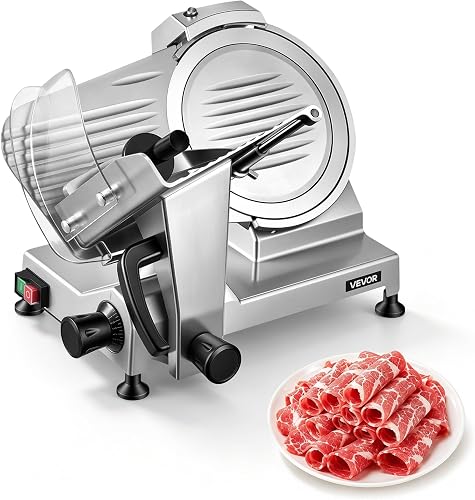
VEVOR 10-Inch Commercial Meat Slicer
8.6/10 our score
See it on Amazon
- 4
 Check it
Borlebbi 200W Electric Meat Slicer
Best for compact electric slicing - 5
 Check it
VEVOR 7.5-Inch Electric Meat Slicer
Best for smaller counters - 6
 Best for a broader thickness rangeCheck it
- 7
 Check it
Nutrichef 200W Electric Meat Slicer
Best for basic electric prep - 8
 Check it
Valley Sportsman Home Meat Slicer
Best for game meat at home
Which meat slicer is best for jerky strips?
The best meat slicer for jerky depends on whether you want adjustable slices or repeated strips at one fixed width. We compared blade size, thickness control, handling and cleanup features to match each slicer with a clear use.
Our score weighs specs and features against what you need for jerky prep.
| Product | Best for | Blade | Thickness range | Power | Our score |
|---|---|---|---|---|---|
| VEVOR 8.6-Inch Electric Meat Slicer | adjustable home batches | 8.6 in, stainless steel | 0–15 mm | 200W | 8.9 |
| Weston Manual Beef Jerky Slicer | uniform quarter-inch strips | 8.7 | |||
| VEVOR 10-Inch Commercial Meat Slicer | larger slicing loads | 10 in, carbon steel | 0–12 mm | 8.6 | |
| Borlebbi 200W Electric Meat Slicer | compact electric slicing | 7.5 in, stainless steel | 0–15 mm | 8.4 | |
| VEVOR 7.5-Inch Electric Meat Slicer | smaller counters | 7.5 in, stainless steel | 0–15 mm | 8.3 | |
| CUSIMAX 8.7-Inch Meat Slicer | a broader thickness range | 8.7 in | 1–20 mm | 200W | 8.0 |
| Nutrichef 200W Electric Meat Slicer | basic electric prep | 7.5 in, stainless steel | 0–15 mm | 200W | 7.8 |
| Valley Sportsman Home Meat Slicer | game meat at home | Two 7.5 in serrated blades | 1–15 mm | 7.6 |
Best meat slicers for jerky by use
These eight slicers cover adjustable home prep, fixed quarter-inch strips and larger slicing loads. Choose a model whose blade and capacity fit the cuts you plan to prepare.
VEVOR 8.6-Inch Electric Meat Slicer: Best for adjustable home batches
- 200W motor
- 0–15 mm thickness adjustment
- 8.6-inch serrated and non-serrated blades
- Removable blade, food pusher and slide bar extender
The broad thickness range and two blade styles make it a flexible choice for home slicing. Removable parts give you access for cleaning after meat prep.
Pros
- Two blade styles included
- Thickness adjusts from 0 to 15 mm
- Food pusher and slide bar extender are removable
Cons
- Semi-automatic operation still requires guiding the meat
- Hand wash only
The VEVOR 8.6-inch model is the most flexible pick for routine home jerky prep. Its 0–15 mm thickness knob lets you set slices from very thin to about 0.6 inches, while the serrated and non-serrated blades give you two cutting styles.
The 200W motor runs at a stated 70–100 RPM. The food pusher helps guide meat toward the blade, and suction cup feet help keep the unit stable on the counter.
The blade, food pusher and slide bar extender come off for cleaning. VEVOR specifies hand washing, so plan to wash those parts by hand after slicing raw meat.
This is a practical fit if you want one electric slicer for varied foods and jerky batches. For strip consistency, mark your preferred thickness setting and use the same setting across a batch.
Weston Manual Beef Jerky Slicer: Best for uniform quarter-inch strips
- 32 stainless steel blades
- Cuts .25-inch strips
- Handles meat up to 5 in wide and 1.25 in thick
- Built-in C-clamp
This manual slicer is made for producing multiple quarter-inch jerky strips at once. Its C-clamp mounts to a flat surface up to 2 inches thick.
Pros
- Cuts up to 15 quarter-inch strips at once
- Includes combs to help prevent jamming
- Includes stainless steel tongs
Cons
- Fixed strip thickness
- Needs a suitable flat surface for the clamp
The Weston is the most purpose-built choice here for jerky strips. Its 32 stainless steel blades cut meat into .25-inch strips, with up to 15 quarter-inch strips passing through at once.
The chute accepts meat up to 5 inches wide and 1.25 inches thick. A built-in C-clamp attaches the slicer to a flat surface up to 2 inches thick, so check the edge of your counter or work table before setting up.
Two stainless steel combs help feed meat through the chute and prevent jamming. The included tongs help you handle meat as you feed it through.
This manual design gives you a repeatable strip width without adjusting an electric thickness dial. It is a focused tool for batch jerky making, rather than a general slicer for deli cuts or other kitchen prep.
VEVOR 10-Inch Commercial Meat Slicer: Best for larger slicing loads
- 10-inch carbon steel blade
- 240W load power
- 0–12 mm thickness adjustment
- Built-in sharpening stone
The wider blade and heavier frame suit larger prep sessions where counter space and storage are available. Its adjustment knob offers control over slice thickness.
Pros
- 10-inch blade
- Built-in sharpening stone
- Removable food-contact parts
Cons
- Heavier than the home models here
- Hand wash only
The VEVOR 10-inch model is the largest electric slicer in this roundup, with a 10-inch carbon steel blade and a heavier 34 lb body. It suits larger prep sessions where you have a sturdy counter and a place to store a full-size machine.
The thickness knob adjusts from 0 to 12 mm. A built-in sharpening stone is included, and the food pusher has raised spikes to hold food during slicing.
The blade, food holder and food pusher are removable, while the stainless steel tray can be wiped clean. VEVOR specifies hand washing for care.
The 240W load power and broader blade make this a more substantial machine than the compact home options. Consider it when batch size is a priority and its weight and footprint work for your kitchen.
Borlebbi 200W Electric Meat Slicer: Best for compact electric slicing
- 200W motor
- Two removable 7.5-inch stainless steel blades
- 0–15 mm thickness adjustment
- Removable food carriage and pusher
Two blade styles and a wide adjustment range offer flexibility for smaller kitchen prep. The removable carriage, blade and pusher help with cleanup.
Pros
- Two removable blades
- Thickness adjusts from 0 to 15 mm
- Compact design for most cabinets and countertops
Cons
- Smaller blade than the VEVOR 8.6-inch pick
- Hand wash only
The Borlebbi offers a smaller electric setup with two removable 7.5-inch stainless steel blades. Its 200W motor and thickness knob cover a stated range of 0–15 mm.
For cleanup, the blade, food carriage, slide-rod extension and food pusher all detach. The slicer has suction cup feet and a food pusher that acts as a blade guard during use.
Its compact design is intended to fit most cabinets and countertops, which may help if a 10-inch commercial slicer is too large for your space. The listed dimensions are 14.17 x 12.2 x 9.64 inches.
This is a reasonable fit for home batches that need adjustable thickness without a large blade. Use the same setting across the meat so strips are closer in thickness.
VEVOR 7.5-Inch Electric Meat Slicer: Best for smaller counters
- 200W motor
- Two 7.5-inch blades
- 0–15 mm thickness adjustment
- Removable blade, food pusher and slide bar extender
This smaller VEVOR model keeps the same stated thickness range as the 8.6-inch version in a lighter package. It includes both serrated and non-serrated blades.
Pros
- Two blade styles included
- Lightest electric slicer in this roundup
- Removable parts for cleaning
Cons
- Smaller blade than the 8.6-inch VEVOR
- Hand wash only
The VEVOR 7.5-inch model suits smaller kitchens and shorter prep sessions. It shares the 200W motor and 0–15 mm adjustment range of the larger VEVOR home model, but weighs 8.4 lb and uses a 7.5-inch blade.
It includes serrated and non-serrated stainless steel blades for different foods. The food pusher, blade and slide bar extender are removable, and suction cup feet help stabilize it on a work surface.
The smaller blade can make feeding wider pieces less convenient than on an 8.6-inch or 10-inch slicer. For common home cuts, though, the adjustable dial gives enough range to choose a jerky thickness and keep it consistent.
Pick it if storage and a lighter machine matter more than the largest cutting surface. It is also a useful option when you want a second blade style for other kitchen jobs.
CUSIMAX 8.7-Inch Meat Slicer: Best for a broader thickness range
- 200W motor
- 8.7-inch blade
- 1–20 mm thickness adjustment
- Removable blade, food pusher and food carriage
Its adjustment range reaches 20 mm, giving you more room for thicker cuts than most picks here. Two blades support different foods, and the carriage comes off for cleaning.
Pros
- Widest stated thickness range here
- Two blade styles
- Removable food carriage
Cons
- Instructions say not to slice frozen meat or meat with bones
- Do not run continuously for more than 7 minutes
The CUSIMAX has the broadest stated adjustment range here, from 1 to 20 mm. That gives you flexibility to cut thicker pieces as well as thin slices, using its 8.7-inch blade and 200W motor.
It comes with serrated and non-serrated blades, plus a removable food carriage and food pusher. The maker's instructions say not to slice frozen foods, meat with bones or food in wrappers, and not to run the appliance continuously for more than 7 minutes.
Those operating limits matter if you prepare a large batch. Work in shorter sessions, keep the meat boneless and follow the instructions for cleaning and handling.
Choose this model if a wider thickness range is a priority and your prep fits those limits. Its 1 mm minimum is also a little less suited to the thinnest cuts than models that start at zero.
Nutrichef 200W Electric Meat Slicer: Best for basic electric prep
- 200W power
- 7.5-inch stainless steel blade
- 0–15 mm thickness adjustment
- Removable blade and food carriage
The adjustable dial covers thin to thicker slices, and the blade and carriage detach for cleaning. Its compact size can suit a kitchen with limited storage.
Pros
- Adjustable up to 15 mm
- Removable blade and carriage
- Food pusher included
Cons
- One tooth blade included
- Hand wash only
The Nutrichef is a compact electric option with a 7.5-inch stainless steel blade and 0–15 mm thickness adjustment. The 200W slicer includes a food pusher and an adjustable dial for different slice thicknesses.
Its blade and food carriage detach for cleaning, and the stated dimensions are 13.9 x 9.9 x 10.9 inches. Hand washing is the care instruction.
Only one tooth blade is included, so this model offers fewer blade choices than several other picks here. Still, its smaller dimensions and adjustable dial suit occasional home prep when storage space matters.
Use the food pusher to guide the meat, and clean the blade and carriage after raw meat prep. For jerky, choose a thickness and repeat it through the batch.
Valley Sportsman Home Meat Slicer: Best for game meat at home
- 180W motor
- Two 7.5-inch serrated blades
- 1–15 mm thickness adjustment
- Removable design
The two serrated blades and adjustable thickness suit home prep that includes game meat. Its stated range begins at 1 mm rather than zero.
Pros
- Two serrated blades
- Adjustable thickness
- Non-slip feet and food pusher
Cons
- Lowest score in this roundup
- Hand wash only
The Valley Sportsman slicer is aimed at home food prep that includes game meat. It has a 180W motor, two 7.5-inch serrated blades and thickness adjustment from 1 to 15 mm.
Its non-slip feet, blade guard and food pusher support controlled slicing. The blade is removable for cleaning, and the unit weighs 10 lb.
The maker suggests chilling ingredients at 3–4°C for 1 hour for cleaner cuts. Treat that as preparation guidance, and follow the slicer's safety instructions while handling meat.
This is a lower-ranked pick because the stated range starts at 1 mm and the product information gives fewer blade styles than some alternatives. It can still suit home game-meat prep when its size and controls fit your routine.
What thickness should you choose for jerky?
A consistent thickness matters more than chasing one exact setting, because strips that are close in size are easier to dry evenly. Many jerky makers start near 1/8 to 1/4 inch, then adjust for their preferred chew.
A slicer's dial may use millimeters, so a setting near 3–6 mm is a useful starting range for that thickness target. Cut a small sample first and check it before slicing the rest of the meat.
For more detail on choosing a cut and grain direction, see our guide to the best cuts of meat for jerky. If you're preparing venison, our article on how to cut venison for jerky covers the same decisions for game meat.
What should you check before buying a jerky slicer?
The best slicer for your kitchen is one you can control safely, clean fully and store between batches. Focus on blade size, adjustment range, food support and how the machine fits your counter.
- Thickness control: An adjustable knob helps you match slices to a recipe; a fixed-strip tool provides repeatable cuts at one size.
- Blade size: A larger blade can accommodate broader pieces, while compact models are easier to store.
- Food support: A pusher or chute helps hold meat away from the blade during feeding.
- Cleanup: Removable blades and carriages give you better access to food-contact areas.
- Batch size: A manual jerky slicer cuts multiple strips at once, while an electric model may be easier to use for varied kitchen prep.
- Counter and storage space: Check the slicer's stated dimensions and weight against where you'll use and store it.
Slicing is only one part of making jerky. Our guide to dehydrators for beef jerky can help you choose the drying equipment for the next step.
Which jerky slicer should you choose?
Choose the VEVOR 8.6-inch model if you want adjustable electric slicing with two blade styles for home batches. Choose the Weston if you want repeated quarter-inch strips, or the 10-inch VEVOR if a wider blade and heavier machine fit your prep space.
If you mostly process game, compare the best vacuum sealers for game meat for storing finished jerky and other cuts. Match your slicer to your strip thickness and batch size, then keep each batch consistent.
Our top 3 picks at a glance
-
1
Best for adjustable home batches
VEVOR 8.6-Inch Electric Meat Slicer
8.9/10 our score
See it on Amazon -
2
Best for uniform quarter-inch strips
Weston Manual Beef Jerky Slicer
8.7/10 our score
See it on Amazon -
3
Best for larger slicing loads
VEVOR 10-Inch Commercial Meat Slicer
8.6/10 our score
See it on Amazon
Frequently asked questions
What type of meat slicer works best for jerky?
For adjustable slice thickness across different cuts, choose an electric slicer with a thickness knob. A manual jerky slicer can be a better fit when you want batches of consistent quarter-inch strips.
Match the tool to your preferred strip thickness, batch size and cleanup routine.
How thick should you slice meat for jerky?
Many home recipes use strips around 1/8 to 1/4 inch thick, but the best thickness depends on your texture preference and drying method. Consistent strips dry more evenly than mixed thicknesses.
See our guide to how thick to cut jerky before setting an adjustable slicer.
Can you use an electric meat slicer on raw meat?
Yes, an electric meat slicer can cut raw boneless meat when its instructions allow it. Keep the meat chilled enough to handle firmly, use the food pusher, and clean food-contact parts carefully after slicing.
Some models warn against frozen meat or meat with bones, so check the instructions for your slicer.
Is a manual jerky slicer better than an electric slicer?
A manual jerky slicer can produce a set strip thickness in repeated passes, while an electric slicer offers an adjustable range for different cuts. The Weston here cuts quarter-inch strips and can process up to 15 at once.
Choose based on whether fixed strips or flexible thickness matters more to you.