Do Food Dehydrators Use a Lot of Electricity?
No, most food dehydrators don't use a lot of electricity. They draw about as much as a small kitchen appliance, roughly 350 to 600 watts, and a full batch usually costs less than running an oven for the same job.
On this page (7 sections)
- What wattage do food dehydrators actually draw?
- How do you work out what a dehydrator costs to run?
- Why does drying time matter more than wattage?
- Does a higher wattage always mean a bigger power bill?
- Which foods and settings push energy use up?
- How can you cut a dehydrator's electricity use?
- What should you remember about dehydrator electricity?
No, most food dehydrators don't use a lot of electricity. They draw about as much as a small kitchen appliance, roughly 350 to 600 watts, so a full batch usually costs less than running an oven for the same job.
The wattage on the box looks modest next to a 2,000-watt oven or a 1,500-watt space heater. If you've wondered whether food dehydrators use a lot of electricity in real terms, the answer sits in two numbers: watts and hours.
This guide breaks down what those numbers mean for your power bill and how to keep a batch of jerky or apple slices from running longer than it needs to.
What wattage do food dehydrators actually draw?
A typical home dehydrator runs between 350 and 600 watts. The three Cosori models used here show the range clearly, and all of them sit well below a standard oven.
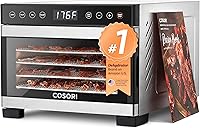
The Cosori 5-Tray BPA-Free Dehydrator draws 350 watts. The Cosori 5-Tray Stainless Steel Dehydrator draws 480 watts.
The Cosori 6-Tray Stainless Steel Dehydrator draws 600 watts. Bigger drying space and a more powerful fan generally mean more watts, but the jump is small compared with most kitchen heat appliances.
For context, a microwave runs about 1,000 watts, a toaster about 1,200 and an electric oven 2,000 to 5,000. A dehydrator is closer to a slow cooker or a rice cooker in draw.
It runs longer than those, which is why the hours matter as much as the watts. Still, the peak load never approaches what a stove or space heater pulls from a circuit.
One practical note: most dehydrators plug into a standard 120-volt outlet and run on a normal household circuit. You won't trip a breaker by adding one to a counter that already has a few small appliances on it.
How do you work out what a dehydrator costs to run?
Multiply watts by hours, then divide by 1,000 to get kilowatt-hours. That figure times your electricity rate gives the running cost for the batch.
Take the 350-watt Cosori 5-Tray BPA-Free Dehydrator running 12 hours. That's 350 x 12 = 4,200 watt-hours, or 4.2 kWh.
At a typical residential rate, the batch costs well under a dollar. The 600-watt Cosori 6-Tray running the same 12 hours uses 7.2 kWh, still around a dollar at most common rates.
Run the same math on a 480-watt unit for 10 hours and you land at 4.8 kWh. The totals move with drying time more than with wattage, so a longer run on a low-watt machine can cost more than a shorter run on a high-watt one.
Your actual rate comes from your utility bill. Rates vary by region and time of day, so use your own figure rather than a national average when you want a close estimate.
For a deeper walkthrough of the math and how a specific model performs, see how much electricity does a dehydrator use.
Is a dehydrator cheaper than an oven for jerky?
Yes, in most cases. An oven uses far more watts and heats a much larger space than a dehydrator, so the same tray of beef jerky usually costs less in a dedicated machine.
An oven at 2,000 watts running 5 hours uses 10 kWh. The 600-watt Cosori 6-Tray running 8 hours for jerky uses 4.8 kWh.
Even with the longer drying time, the dehydrator comes out ahead because its wattage is a fraction of the oven's.
The gap widens when you factor in the oven heating the whole kitchen. A dehydrator dries food in a small chamber, so the heat stays where it's needed.
For anyone making jerky regularly, the savings add up over a year of batches.
Why does drying time matter more than wattage?
Energy used equals watts times hours, so the hours carry the real weight. A modest-watt machine that runs all day can use more than a high-watt model that finishes faster.
Fruit and vegetables take the longest. A full tray of apple slices can run 6 to 12 hours depending on thickness and humidity.
Beef jerky usually takes 4 to 8 hours. Those long runs are where the kilowatt-hours build up, not in the draw itself.
This is why a 600-watt dehydrator with strong airflow can beat a 350-watt model on total energy. The faster machine dries food in fewer hours, and fewer hours means fewer kilowatt-hours.
The wattage number alone doesn't tell you the running cost; the combination does. Our guide to how long to dehydrate beef jerky breaks down the time ranges by method and thickness so you can estimate a batch.
Temperature also affects time. Running higher, within a recipe's safe range, shortens the run.
A dehydrator that reaches 165°F lets you finish jerky in fewer hours than one capped lower.
Does a higher wattage always mean a bigger power bill?
No. Wattage is the rate of use, not the total.
A higher-watt machine that dries faster often uses less energy overall than a slow, low-watt one.
The 600-watt Cosori 6-Tray Stainless Steel Dehydrator is the most powerful model in this group. It also has the most drying space, at 6.5 square feet across six trays.
If it dries a full batch in 8 hours that a 350-watt model needs 14 hours to finish, the total energy can come out lower for the big machine.
The catch is that you need to fill the trays to get the benefit. Running a big machine half-empty for the same time wastes energy relative to the food produced.
Size the dehydrator to your typical batch and the wattage stops being the deciding factor.
Which foods and settings push energy use up?
Long, wet foods and high humidity push the hours up. Fruit with high water content, thick-cut vegetables and full trays of meat all extend the run time.
Apples are a good example. Thin slices dry faster than thick ones, and a humid kitchen slows the process.
Our guide to how to dehydrate apples in a food dehydrator covers slice thickness and timing so a batch doesn't run longer than it needs to. The same principle applies to tomatoes, peppers and herbs.
Loading trays too full is another hidden cost. Overcrowding blocks airflow, so food dries unevenly and the machine runs longer.
Spacing slices and rotating trays partway through keeps the run time close to the recipe's estimate.
The temperature setting matters too. Running below what a recipe calls for stretches the batch.
Running within the safe range for jerky, which the USDA puts at 165°F, finishes the job in fewer hours.
How can you cut a dehydrator's electricity use?
Fill the trays, keep the food thin and even, and run the machine only as long as the batch needs. These steps cut hours, and hours are what drive the bill.
Start with a full load. A dehydrator running 12 hours half-empty uses the same energy as one running 12 hours full, so pack trays sensibly without blocking airflow.
Slice food evenly so everything finishes at the same time and you don't run the machine past the last piece.
Use a timer. Most models let you set a run time and shut off automatically.
The Cosori 5-Tray BPA-Free Dehydrator runs up to 48 hours in 30-minute steps with an automatic shutoff, so it won't keep drawing power after the food is done. The Cosori 5-Tray Stainless Steel Dehydrator offers a 48-hour timer and four presets.
Keep the machine out of direct sun and away from the stove. A hot room makes the dehydrator work longer to hit its temperature.
Unplug it between batches to remove any small standby draw.
Which model suits a low-energy household?
For most homes, the 480-watt Cosori 5-Tray Stainless Steel Dehydrator balances draw and drying space. Its stainless trays and rear fan dry food evenly in fewer hours than a basic low-watt unit, and it reaches 176°F for safe jerky.
If you dry small batches and want the lowest draw, the 350-watt Cosori 5-Tray BPA-Free Dehydrator runs quiet below 47 dB and still reaches 165°F. It's the lightest of the three at 4.9 pounds and expands to seven trays.
For large batches and the shortest runs, the 600-watt Cosori 6-Tray Stainless Steel Dehydrator earns its higher draw by drying more food at once. Compare the full range in our guide to the best food dehydrators for home use.
What should you remember about dehydrator electricity?
Do food dehydrators use a lot of electricity? **No.
They draw 350 to 600 watts and a full batch usually costs less than an oven run**, because the watts stay low and the small chamber holds heat.
Pick a machine that matches your typical batch, fill the trays, and set the timer so it shuts off when the food is done. For a low-draw pick, the 350-watt Cosori 5-Tray BPA-Free Dehydrator covers small batches well.
For the best balance of speed and energy, the 480-watt Cosori 5-Tray Stainless Steel Dehydrator is the one to choose. Step up to the 600-watt Cosori 6-Tray only if you regularly dry large batches and want the shortest runs.
Frequently asked questions
Do food dehydrators use a lot of electricity compared with an oven?
No. A dehydrator runs at 350 to 600 watts, while a typical oven runs at 2,000 to 5,000 watts.
Even with longer drying times, a dehydrator usually uses less energy for the same batch of jerky or fruit.
How much electricity does a 500-watt dehydrator use in a day?
At 500 watts running 12 hours, it uses about 6 kilowatt-hours. At a typical residential rate, that comes to less than a dollar for the whole batch, though your rate and run time will change the total.
Does a higher-wattage dehydrator cost more to run?
Only if it runs the same number of hours. A 600-watt model that finishes in 8 hours can use less total energy than a 350-watt model that needs 14 hours, so drying speed matters as much as wattage.
What uses more electricity, a dehydrator or a slow cooker?
A slow cooker typically runs 200 to 300 watts for 6 to 8 hours. A dehydrator draws more watts but runs longer for jerky and fruit, so the two land in a similar range for a full session.
Can I leave a food dehydrator running overnight to save on electricity?
Running overnight doesn't lower the energy used, since the total depends on wattage times hours. It does suit quiet models, though, and several dehydrators run below 48 dB, so you can dry food while you sleep.
Does a dehydrator use electricity when it's switched off?
A dehydrator with a digital panel may draw a small standby current for its display and timer, typically a watt or less. Unplugging it between batches removes that draw completely.